
Comal County Sex Offender Checks
The Texas Public Sex Offender Registry is the main public search for Comal County. Texas DPS operates the central database under Code of Criminal Procedure Chapter 62. Local law enforcement does the registration work and submits changes. The Comal County Sheriff serves as a local authority in unincorporated areas, while a municipal police agency may register a person who lives inside its city. That split explains why a caller may be directed to a city department even though the same public profile appears in the DPS system.
Start with the facts already known. A full name helps find one person. A street, ZIP code, city, or Comal County filter supports neighborhood awareness. Search both aliases and common name forms when appropriate, but do not treat a name match as proof of identity. The registry carries public notification data and disclaims a guarantee that every fact is current. Confirm an address or status with the law enforcement agency shown as the registering authority before relying on it for a safety decision.
Comal County Offender Name and Address Searches
Name and place searches solve different problems. A name query follows a known individual and can be narrowed with first and middle names. An address query examines a place and nearby results, while city, ZIP, and county controls broaden or narrow the map. The address route is more useful when the goal is community awareness rather than locating one known profile. Radius choices depend on the live interface, so select from the options the registry actually presents instead of assuming a fixed distance.
The official DPS search form shows how Texas organizes these paths.
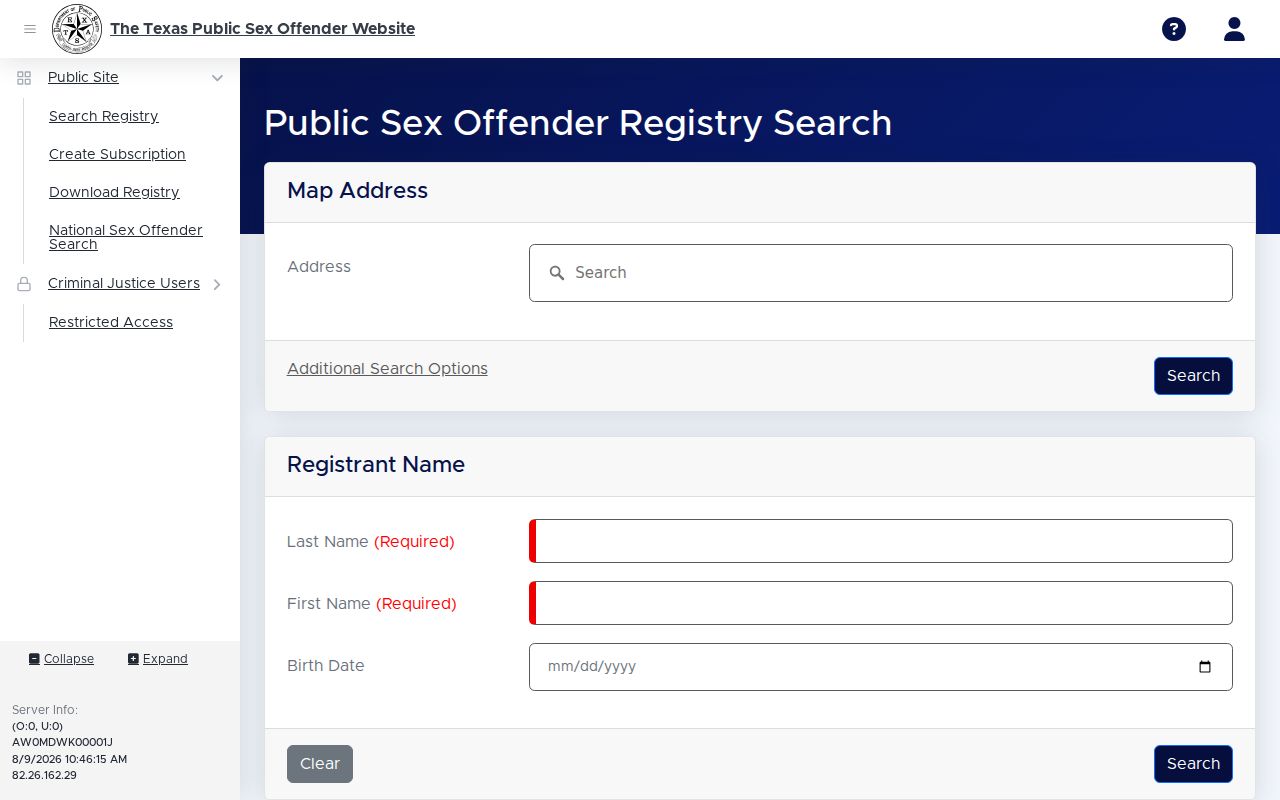
The form supports a careful Comal County search without copying any registrant's identity into a separate list.
Texas Public Sex Offender Registry Searches
DPS combines information supplied by local registration authorities into the Texas Public Sex Offender Registry. Searchers can filter the central system to Comal County, but should still note the registering agency on a profile. City limits and county lines do not always track one another around New Braunfels and Schertz. The agency field is therefore a better guide for follow-up than a mailing-city label alone.
- Open the DPS registry and read its conditions and public-information warning.
- Choose a name search or enter an address, city, ZIP code, or Comal County filter.
- Compare aliases, photographs, descriptors, and place data before selecting a possible match.
- Open the profile, read the offense and registration fields, then verify current concerns locally.
Keep the search terms and the profile's registering agency. Those details make a later Comal County verification specific and reduce the risk of confusing people with similar names.
| Field Label | Type | Required | Notes |
|---|---|---|---|
| Last Name | Text | Name path | Use the legal spelling; live partial-match behavior may vary. |
| First and Middle Name | Text | Optional | These fields narrow a Comal County name result. |
| Address | Text | Location path | Enter the street or address format accepted by the live form. |
| City or ZIP Code | Text or select | Optional | Use New Braunfels, Schertz, Bulverde, or a five-digit ZIP. |
| County | Dropdown | Optional | Select Comal for a countywide result set. |
| Radius | Dropdown | Address path | Use the distances offered by the current interface. |
A profile can change as local authorities report new addresses or status facts. Treat the live DPS record and direct agency confirmation as the current sources.
Comal County Sex Offender Registration Authorities
Texas law assigns registration and verification to local law enforcement. The Comal County Sheriff handles the unincorporated county role, while the New Braunfels Police Department, Schertz Police Department, and Bulverde Police Department may handle residents within their jurisdictions. Each local authority keeps its own registration records while sending public fields and updates to DPS. A change can therefore begin with a local office before it appears in the central search. That is why the local authority is the right place to ask about a potentially stale address or suspected failure to report.
DPS publishes the program framework and the duties that connect local registration to the central registry. The Texas registration program overview provides that official context.
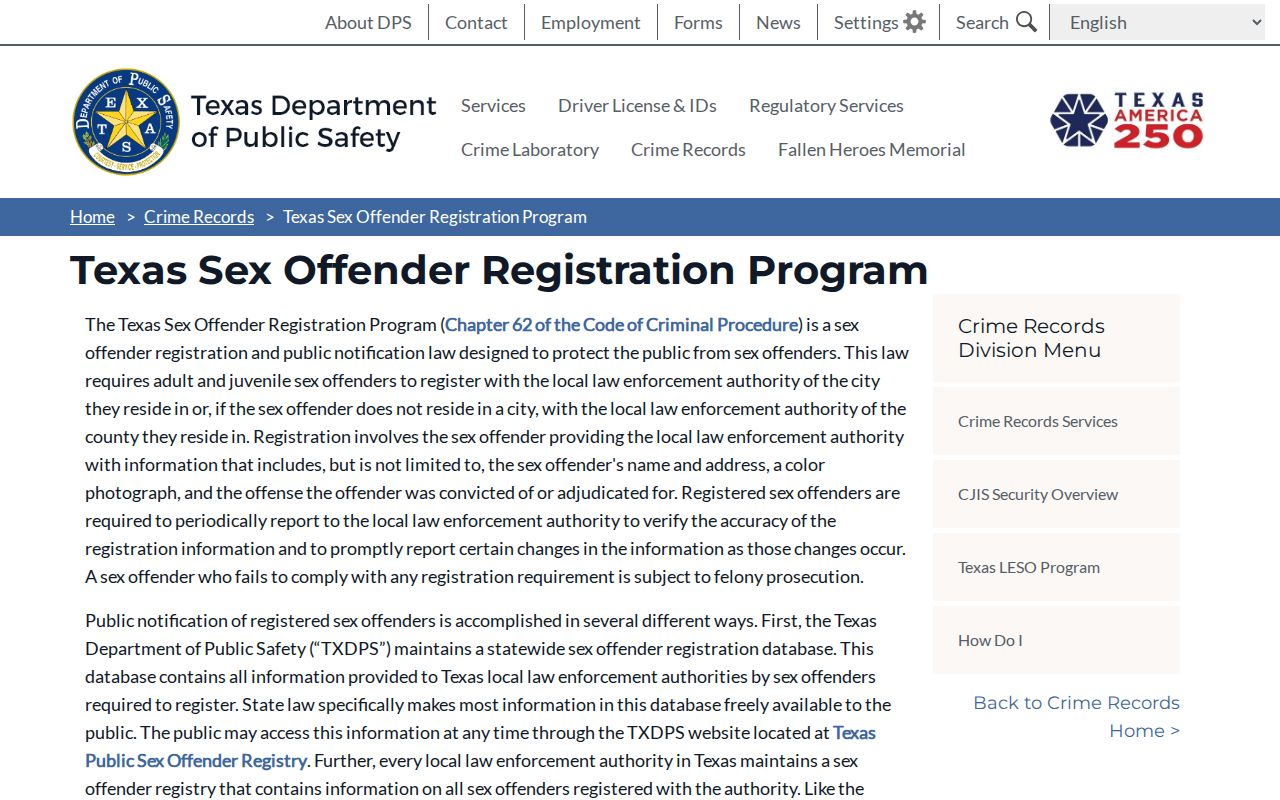
The program view helps separate the local verification task from the statewide public search.
Registry Profiles: What They Show
A public registry profile is structured notification data. It can include names and aliases, a photograph, physical descriptors, a registered address, status, reportable offense information, and other fields that Chapter 62 makes public. Read the offense statute and conviction or adjudication data together. A risk level, when shown, is an assessment field and is not the same thing as a federal SORNA tier. Vehicle and school information may also appear when Texas law authorizes public display.
| Name & Aliases | Legal name and publicly reported alternate names used to distinguish profiles. |
|---|---|
| Photo & Description | Photograph plus permitted age or birth information, height, weight, hair, eyes, and sex or race descriptors. |
| Registered Address | The public residence or other location information submitted through the local authority. |
| Offense & Statute | Reportable offense and conviction or adjudication information, including the cited law when supplied. |
| Risk Information | A numeric risk level may appear, but it does not create a simple Texas Tier I, II, or III duration system. |
| Status and Identifiers | Registration status, physical marks or tattoos, and public vehicle or school fields when authorized. |
Duration cannot be calculated from a risk number alone. The reportable offense, discharge date, juvenile or adult status, and controlling Texas provision must be read together.
Comal County Stale Registry Addresses
If an address appears stale, do not confront the listed person or household. Save the public profile link, note the field in question, and contact the registration authority shown on the record. For an unincorporated Comal County matter, the Sheriff's main line is 830-620-3400. Inside a city, contact that police department. Local staff can compare the report with registration duties and submit a verified update to DPS when appropriate.
A public database can lag behind a local report, and the registry disclaims a guarantee that all facts are current. A mismatch is a reason to seek official verification, not proof of noncompliance. Use 911 only when there is an immediate emergency. For a routine discrepancy, provide a clear factual observation and let law enforcement decide what follow-up is warranted.
Comal County Registry Privacy Limits
Article 62.005 draws a line between public safety information and private data. A public Comal County profile does not disclose a Social Security number, driver's license number, personal phone numbers, or victim-identifying details. Employer names, addresses, and phone numbers are also excluded. The absence of those fields is intentional, not a broken profile. Public access is meant to support awareness while protecting information that does not belong in open notification records.
Do not try to fill gaps through unofficial people-search sites. Those sources can be stale, may mix identities, and are not the Texas registration record. If a public field appears wrong, keep the profile URL and contact the listed registering authority. The local office can evaluate a possible reporting problem; a searcher should not investigate or confront the person.
Registration Levels and Duties in Texas
Texas uses offense-based lifetime and ten-year registration duties, with separate juvenile rules and possible risk information. It does not place every public profile into a simple three-tier duration chart. The precise offense and statutory category control. Verification frequency can also depend on the governing provision and the local authority's instructions, so the profile and DPS program guidance should be checked together.
| Texas Category | Duration | Public Meaning |
|---|---|---|
| Adult lifetime categories | Lifetime for sexually violent and other listed Chapter 62 categories | Confirm the exact offense under Articles 62.101 and 62.102 and the DPS FAQ. |
| Other adult reportable cases | Generally ten years after discharge from custody, parole, or community supervision | The specific offense and case history can change the calculation. |
| Juvenile registration | Specialized duration and relief rules | Adult duration rules should not be applied automatically; some procedures limit public access. |
| Numeric risk level | Assessment field, not a duration by itself | It may appear in the registry but is not the same as federal tier terminology. |
Local verification schedules are not supplied as one universal public frequency in the research. Follow the profile and registering authority rather than inventing a tier-based schedule.
Comal County and NSOPW Searches
The National Sex Offender Public Website adds a cross-state layer. It is useful when a person may have moved or when a safety search crosses Texas borders. DPS remains the primary source for a Texas profile, while NSOPW connects participating jurisdictions. Neither source replaces local verification. Search terms and update timing can differ, so compare the results and follow the agency information attached to the relevant record.
The national portal shows why a Comal County search sometimes needs a wider view.
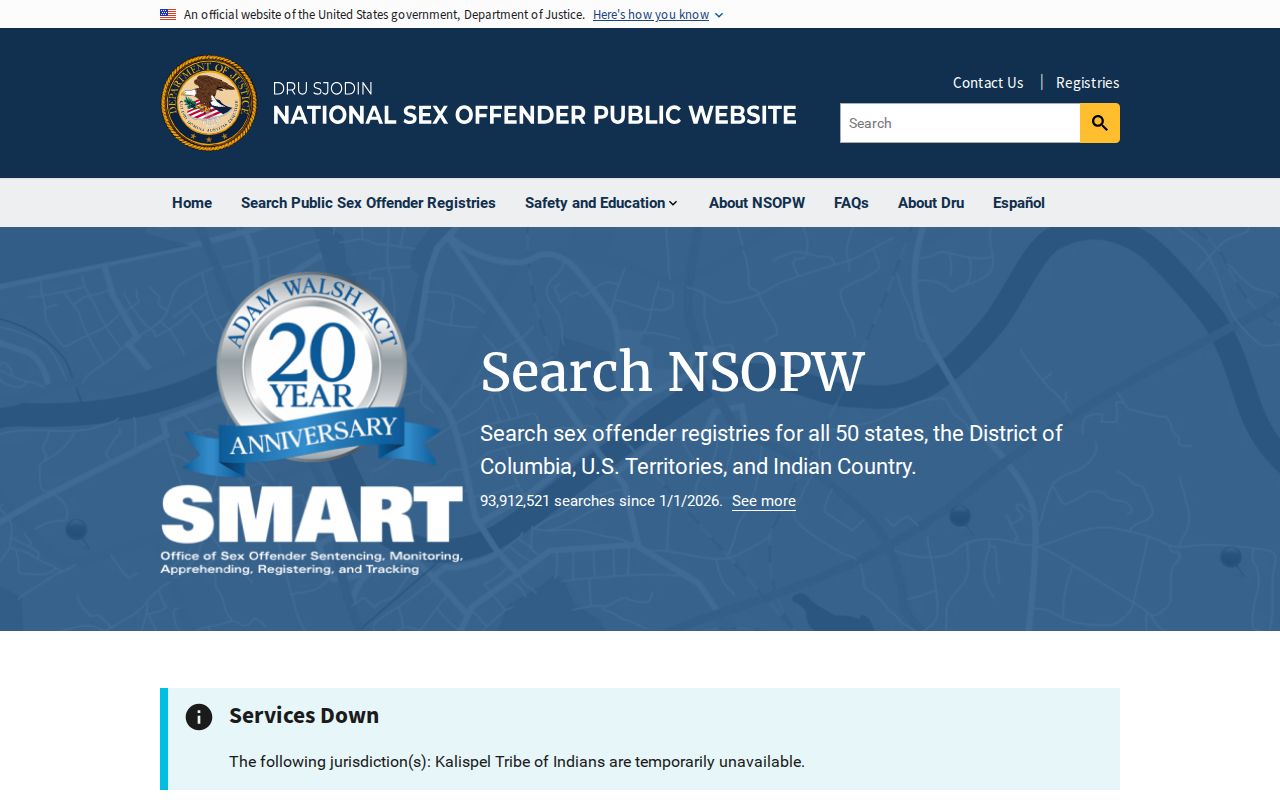
Use that broader reach for cross-state context, then return to DPS and the registering authority for Texas facts.
Using Registry Information Lawfully
Registry information supports personal, family, and community safety. It may help residents plan routes, discuss age-appropriate safety rules, or report a fact that appears inconsistent with a public profile. It is not an invitation to threaten, shame, follow, or confront a listed person or anyone in that household. Texas does not impose one universal statewide school-distance rule through the registry program itself. A local ordinance or a supervision condition may create a separate limit, so do not infer illegality from map distance alone.
Report suspected noncompliance to the responsible law enforcement authority. Use 911 only for an emergency. For a nonemergency issue in unincorporated Comal County, the Sheriff's main line is 830-620-3400; within a city, contact that police department. Provide the profile, the field in question, and a clear factual observation. Let trained staff verify it.
Texas statutory warning: Code of Criminal Procedure Chapter 62 provides registry information for lawful notification. Harassment, threats, intimidation, or other criminal misuse can bring criminal or civil consequences.